
The comparison trap: How social media can affect your mental health
August 3, 2026Categories: Blog Posts
Tags: Mental Health, Wellness
It’s a perfectly ordinary evening. Dinner is finished, quick workout complete.
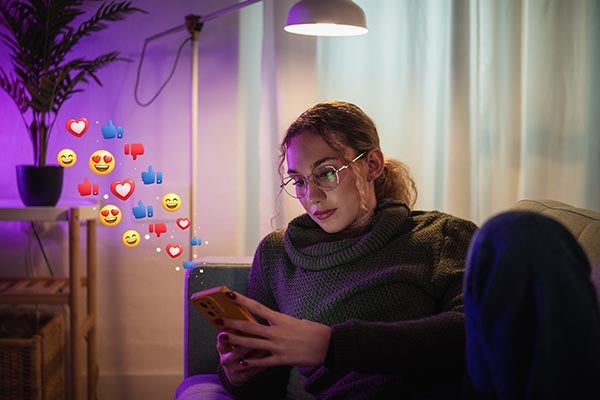 You curl up on the couch, excited to unwind with a few minutes of social media scrolling. The first post you see announces an engagement. The next is a picture-perfect family vacation. Then comes a celebrity’s dramatic weight loss, followed by an influencer promising the one skincare product you “need” to look 10 years younger.
Five minutes ago, you felt content in your life. Now, you’re wondering if you’re falling behind.
While social media can inspire and connect us, it also has a sneaky way of making us feel “less than” if we compare ourselves to the carefully curated snapshots we see online.
When done in excess, this pattern can quietly chip away at our mental wellbeing, contributing to feelings of anxiety, depression, dissatisfaction and unrealistic expectations about everything from appearance to relationships to finances.
According to Anna Zacharcenko, PsyD, a clinical health psychologist and the director of the behavioral health education residency program at St. Mary Family Medicine Bensalem, this phenomenon is known as upward social comparison—when we deem someone as superior to ourselves. As a result, our mental health, self-esteem and overall view of our life become negatively impacted.
“Comparisons made on social media are more likely to be upward, as many users tend to present an idealized version of themselves and their lives. We see that with the regular layperson toward famous figures, whether they’re actors or models. Social media users are likely to believe that others are happier and living a better life than they are,” says Dr. Zacharcenko.
The grass isn’t always greener
Upward comparison occurs largely because of social media’s curated nature. Typically, people are only going to post the highlights—the end of a successful weight loss journey, the smiling children on vacation, the exciting new job opportunity. From the outside looking in, it’s easy to assume their life is better simply because you’re only seeing the highlight reel.
Not shown are the real-life struggles behind those picturesque posts—the months of sweat and tears to achieve that goal weight, the kids’ tantrum minutes before the happy shot was snapped, the hundreds of job applications submitted before finally receiving an offer.
“People get in their head that the other person is living their best life—and that’s a fallacy,” says Dr. Zacharcenko. “It’s a distortion of reality.”
The impact of Hollywood
When it comes to upward social comparison, well-known actors, singers and models are often at the center point of who we deem to be “superior.” Though it’s natural to look up to these individuals in some fashion, negative effects happen when we feel the need to emulate their every move:
Comparison: Celebrities boasting a dramatic weight loss.
The effect: Unhealthy eating habits, misuse of GLP-1 medication or body dysmorphia.
Comparison: Beauty influencers who promote makeup and supplements.
The effect: Overspending on unnecessary products to try and improve appearance.
Comparison: The famous mom whose body “bounced back” mere weeks after childbirth.
The effect: Feeling like you’re failing as a mother.
Social media, explains Dr. Zacharcenko, detracts from the reality of life. This is especially true for women, who are most vulnerable to upward social comparison. They often forget that the public figures they’re comparing themselves to have a surplus of stylists, trainers and licensed medical professionals at their disposal.
“I have many tell me they want to capture an elegant look they saw online. They think the woman looks ‘perfect’ with her hair and makeup and wonder why they don’t look that way,” says Dr. Zacharcenko. “You don’t have that lifestyle. You’re working 9 to 5. You’re raising children or taking care of grandchildren.”
Upward social comparisons in the real world
Though celebrities are often the subject of upward social comparison, a person doesn’t have to be rich and famous with millions of followers to be viewed as superior by someone else. While scrolling on social media, a simple post by a loved one can spark feelings of inferiority:
Comparison: The friend who achieved a life milestone, such as marriage or having a child.
The effect: Diminishing your own accomplishments because they might look different.
Comparison: The happy couple who seem to have it all together.
The effect: Viewing your own partner as not good enough, which can lead to infidelity.
“Everything looks shiny on social media. But you must remember that as humans, we want to present our best selves to the world and protect our image. The posts on Instagram are going to be a perfect highlight reel of their life,” says Dr. Zacharcenko. “It’s easy to assume their life is better, but your life is just as amazing even if you don’t have the same things. The grass isn’t always greener—it’s greener where we water it.”
How to stop comparing and start loving your own life
Unless you delete social media for good, it’s practically impossible to avoid seeing curated posts that could trigger upward comparison. To avoid negative impacts, it’s important to actively limit your scroll time and take steps to be more present in your life.
The best way to do this is by practicing gratitude. At the end of each day, Dr. Zacharcenko recommends jotting down three things you’re grateful for. This simple activity is guaranteed to lift your mood and force you to think about what went well instead of comparison and a sense of “lack.”
“If you’re writing down every day what you appreciate about yourself, your life and the people in it, that’s going to build. The more you do it, you’re training the positive sentiment muscle in your brain,” says Dr. Zacharcenko. “As human beings, we’re wired to survive. We look for what’s threatening in the environment, including what we perceive to be threats to our self-image. We look for things that say we’re not good enough. Instead, let’s get our brains to look at what is good and beneficial in our lives.”