
The hidden health effects of doomscrolling and how to break the habit
February 3, 2026Categories: Blog Posts
Tags: Mental Health
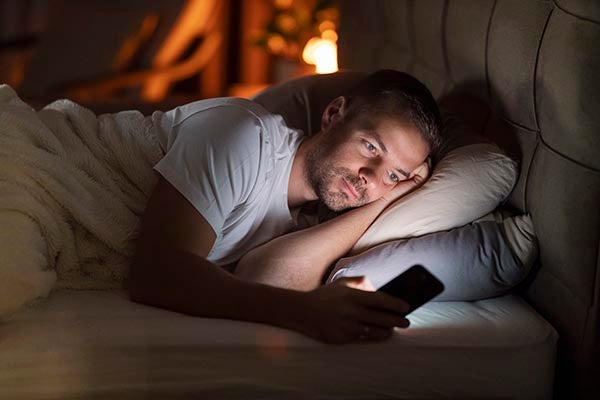 A simple visit to social media to “stay informed” can quickly—and unintentionally—turn into hours of doomscrolling distressing content. Though we may think to ourselves, “Just one more video,” that promise is rarely kept as we get sucked into our tiny, glowing screens. This constant bombardment of negative news and commentary, especially when watched/read first thing in the morning or right before going to sleep, is leaving many people feeling anxious, angry and exhausted, both physically and mentally.
However, life doesn’t need to be this way. According to Maggie Walsh, LCSW, CCTP, a behavioral health specialist with Trinity Health Mid-Atlantic’s Quality Health Alliance, it’s entirely possible to stay in the know about worldly happenings without wreaking havoc on our wellness. Balance and self-care are key to diminishing the harmful effects of doomscrolling.
“There’s some research that says we have hundreds of negative thoughts before we get out of bed in the morning. And that’s not even if we’re looking at our cell phones. We know that most of us are looking at social media or the news, or answering work emails,” says Walsh. “That does not prime us to have a calm day.”
The algorithms of social media have a strategically addictive quality—the types of posts that we engage with the most are shown to us more frequently. For example, if a TikTok user is always watching and liking puppy videos, their feed is instantly flooded with furry cuteness. Similarly, if they spend amble amounts of time on news-centric posts, that’s what their feed becomes.
Understandably, being inundated with such posts creates a bleak narrative, resulting in feelings of anger, depression, anxiety and helplessness. This is especially true given the fact that social media provides 24/7 access, amplifying an ever-growing culture of instant gratification. If a harrowing event occurs, it’s easy to sit for hours refreshing the feed as updates come through every few minutes.
“You can just gobble it up. And you’re not necessarily getting lots of different, opposing viewpoints that get you to think more critically about an issue. That’s by design,” says Walsh.
Social media, explains Walsh, doesn’t need to be given up entirely. She recommends incorporating self-boundaries in small increments, allowing the opportunity to know what’s going on in the world without sacrificing our wellness. These include:
- Tracking how many hours/minutes we spend scrolling social media and reducing that time by 15 minutes each week until it’s at a healthy amount
- Avoiding an early morning doomscroll, as this sets a negative tone for the day
- Refraining from social media right before bed—this can cause a poor night’s sleep and amplify negative feelings the following day
- Meditating and taking some time to pay attention to our thoughts, even if it’s for just a few minutes
- Physical activity—opting for a short walk over doomscrolling can do wonders for one’s mental and physical health
- Practicing kindness in small ways, whether it’s letting someone merge in front of you on the highway or complimenting a stranger
- Finding an accountability partner (friend, loved one, colleague) to talk to and spend time with when things feel too heavy
- Turning agitation into something constructive, such as attending a march or donating to a good cause
“All of this is a form of self-care. It doesn’t mean buying something. Self-care is increasing the ways that we take care of ourselves. If we’re looking at our phones, our computers or TVs right before we go to bed, that is the opposite of what our brain and body wants to calm down and relax,” says Walsh. “The foundation that we lay for ourselves is extremely important. When we’ve slept well, when we’ve exercised, when we take care of ourselves, we’re less likely to react in an extreme or more intense way when we’re feeling calmer within.”
In addition to self-care, Walsh recommends cognitive behavioral therapy (CBT), which helps people observe and recognize negative thoughts before they can manifest into negative actions or behaviors. After spending hours doomscrolling, it’s natural to have thoughts such as, ‘The world is a terrible place’, ‘Everything is bad’, and have that impact how we show up in our daily lives. CBT creates a small distance between what we’re thinking and what we’re experiencing.
“We can be observant and recognize that we’re angry. The amygdala, the part of our brain that we call the ‘fear hub,’ becomes less activated when we name it to tame it because we’re taking an observer’s view,” says Walsh. “We can begin to talk ourselves into having more compassion and patience with ourselves, which then becomes a domino effect. We may be able to be just a little more patient and compassionate with others.”