
Security squad’s fast action saves a life at Saint Francis Hospital
April 8, 2026Categories: Blog Posts
Tags: Emergency Medicine
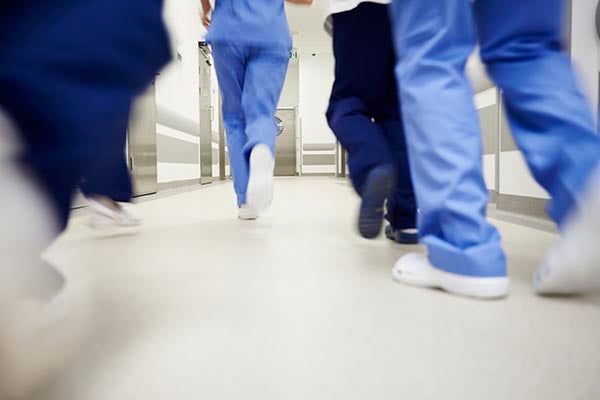 At Saint Francis Hospital, lifesaving care doesn’t just come from doctors and nurses. Even beyond the walls of the emergency department, every colleague plays a part in patient care—including the security squad, who used teamwork, quick thinking and determination to ensure one individual in crisis got the immediate help they desperately needed.
During a recent overnight shift, at approximately 3:30 a.m., Sgt. Mar’Keith Allen-Campbell, Public Safety Officer Marquise Clemment, and Constables Kylil Hinman and Dwanye Coleman rallied together at the Clayton garage to assist a man who overdosed on drugs.
According to Constable Hinman, the event began when a woman requested a wheelchair for her companion, whom she said was able to wheel himself to the hospital entrance. However, after some time passed without their arrival, he became concerned and contacted Sgt. Allen-Campbell. Along with PSO Clemment, the trio got in their patrol vehicle and conducted a perimeter sweep, successfully locating both individuals in the parking garage.
What they discovered was gravely concerning. The woman, who was pregnant, was in a state of distress, reporting that her companion was unconscious and non-responsive due to a drug overdose.
“My first thought was, ‘I can’t let this man die. He’s about to be a father’,” says Sgt. Allen-Campbell. “The next thought was to get him into the Emergency Department as quickly as possible and to dispel the significant others’ worries of the worst-case scenario.”
The squad acted fast—Sgt. Allen-Campbell, Constable Hinman and PSO Clemment got the man out of the vehicle and into a wheelchair, while Constable Coleman went to the ED to alert medical staff of the dire situation in the garage.
But instead of waiting for the medical team to come to them and wasting precious minutes, PSO Clemment—who had only been working at Saint Francis for less than a month—jumped into action. Without hesitation, he got behind the wheelchair and pushed the man up the steep incline from the Clayton garage, down the street and up the ramp into the ED. This was a feat that many would struggle to achieve while walking, let alone running and pushing an unconscious person.
“I knew that moving as quickly as possible would increase the patient’s survival likelihood,” says PSO Clemment. “I was motivated to help, serve and do the best I could for anyone whose life was or is in jeopardy.”
PSO Clemment’s fellow squad members were deeply impressed with and grateful for his initiative.
“His actions taught me one very clear thing about his character. When action calls, he answers without hesitation,” says Sgt. Allen-Campbell. “His actions also showed me that the training we provide is effective and most evident when it truly matters.”
“PSO Clemment’s performance during this crisis reflected his military background and his seamless integration into a team that, despite our personal camaraderie, maintains an unwavering professional focus,” says Constable Hinman. “His addition to the squad has significantly enhanced our operational effectiveness and dedication to the hospital’s mission.”
Constable Coleman adds, “PSO Clemment is a team player and he made an awesome effort in moving very quickly up the ramp to the emergency ambulance doors.”
Ultimately, it was the squad’s trust, teamwork and communication that saved a life. They remained focused during a high-pressure situation, acted decisively without the need for explicit instruction and operated as a cohesive unit, each member proactively supporting the others.
“If we hadn’t trusted each other to quickly play the assigned roles, we could’ve gotten stuck in the garage with no moves made. If we couldn’t work as a bunch of cogs all moving together, it could’ve been someone’s last day,” says Sgt. Allen-Campbell.
Through it all, the squad acted with compassion and empathy—not judgement—toward the man and his companion.
“We treat every individual—regardless of their circumstances or background—with the same care we would extend to our own family members,” says Constable Hinman. “Our goal is to recognize the humanity in everyone we serve, providing necessary help or direction to those who need it most while fulfilling our core duty to protect the hospital community.”
Security officers might not be trained in surgeries or medical procedures, but their sworn duty to protect patients and the surrounding community can be just as lifesaving. The squad’s actions that morning prove they’re more than security—they’re an essential part of the care team.
“We are often the first point of contact, acting as the eyes and ears of the facility before a patient even reaches a clinical provider,” says Constable Hinman. “In high-pressure situations, our ability to identify a crisis, maintain order and bridge the gap between the community and medical staff is what ensures the hospital remains a sanctuary for healing.”
Sgt. Allen-Campbell adds, “You don’t have to be in the most important role within an organization to have a great effect on the community.”