
What to know about kidney stone prevention during National Kidney Month
March 17, 2026Categories: Blog Posts
Tags: Urology
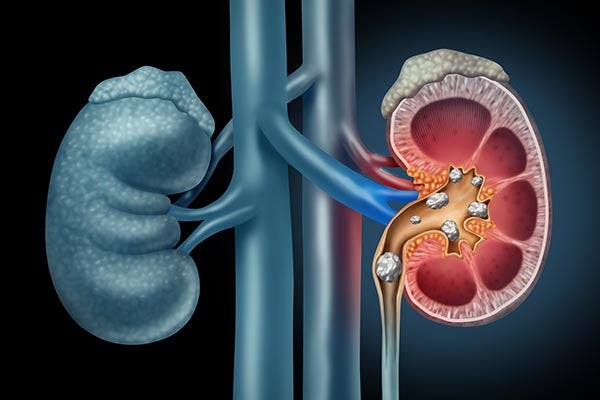 In their lifetime, approximately 1 in 10 people will develop a kidney stone, according to the National Kidney Foundation. Kidney stones occur when the urine has excess amounts of certain materials which together form hard crystals. During National Kidney Month, it’s important to remember that kidney stones aren’t something most people have to live with—in most cases, they’re entirely preventable.
While some individuals are predisposed to kidney stones due to family history, the majority of the population can avoid them through the simple act of hydration. Noah May, DO, a urologist at Comprehensive Urology Darby, explains that lack of water intake is the most common cause of kidney stones.
Calcium oxalate vs uric acid
There are two main types of kidney stones that come from what you eat: calcium oxalate and uric acid. The most common type of stone occurs when there’s too much oxalate or calcium in the urine, and too little water being consumed to flush it out. Excess oxalate can come from tea, nuts, chocolate and dark leafy greens; calcium excess can come from dairy products and antacids like Tums.
“The oxalate that’s in your urine has to be excreted, and if you don’t have enough water intake, then the concentration goes up,” says Dr. May. “If you have enough calcium and oxalate bound together in your urine, and the concentration is too high from lack of water intake, those will precipitate out and form crystals, which get bigger and bigger. That’s why people tend to get kidney stones in the warmer months and more so in the south, the ‘Stone Belt’.”
As for the less common uric acid stones, these are found in individuals with a high salt, high protein diet, and those prone to gout.
Finding the cause
At Comprehensive Urology Darby, it’s not just about diagnosing a kidney stone—it’s also about determining the root cause and helping patients make the necessary lifestyle alterations, like decreasing oxalate, calcium, salt or protein in their diet. Oftentimes, says Dr. May, patients don’t realize that their diet is making them prone to stones.
“Many stones occur because a person made some kind of dietary change to try to be healthier,” he explains. “They started eating a lot of dark, leafy vegetables or they got on some kick where they’re drinking iced tea every day, which has high oxalate. This is how a person who is not prone form a stone has now formed one.”
In addition to considering diet and lifestyle, Dr. May recommends kidney stone patients complete a 24-hour urine collection to determine their water intake and measure the levels of the building blocks of stones in their urine. At least 2-2.5 liters of water is recommended daily, ideally with fresh lemons added, as citrate in lemons interferes with the formation of all types of stones.
“Stones are largely preventable. The main thing is hydration. If your urine looks very dark, you probably need to drink more water. Another thing that can contribute to being dehydrated is caffeine use. If you’re drinking a lot of coffee, caffeinated soda or energy drinks, even though you’re consuming liquid, the caffeine makes you produce more liquid than you consumed, so it can cause dehydration,” says Dr. May.
Kidney stones are most prevalent in men in their 40s and 50s, with another spike in the 70s, though it’s possible for people to get them at any age. If there’s a family history, someone may develop stones as early as their teens.
Symptoms and treatment
Those with a kidney stone will likely not experience any symptoms until the stone leaves the kidney and lodges in the ureter. When this happens, there is usually a sudden onset of severe pain, nausea and vomiting, caused by pressure building up behind the stone. Upon arrival at the ER, patients undergo a CT scan, which determines the size and location of the stone. Bloodwork and urine tests are also completed to make sure there’s not an infection trapped behind the stone.
“If they have a stone that’s of a size that can reasonably be passed—3-5mm—and they have no signs of infection, we usually don’t need to admit them,” says Dr. May. “We can let patients try to pass it on their own for upwards of a month. Fortunately, stones rarely cause any lasting damage to the kidney.”
When a stone is too large to be passed naturally, a same-day outpatient procedure called ureteroscopy is performed, which involves going into the ureter with a skinny, flexible scope to laser and remove the stone.