
Faces of Trinity Health Mid-Atlantic: Regina Poole
January 16, 2026Categories: Faces of Trinity Health Mid-Atlantic
This series spotlights non-provider colleagues who are helping create a safe, healing and compassionate environment both in and out of the hospital.
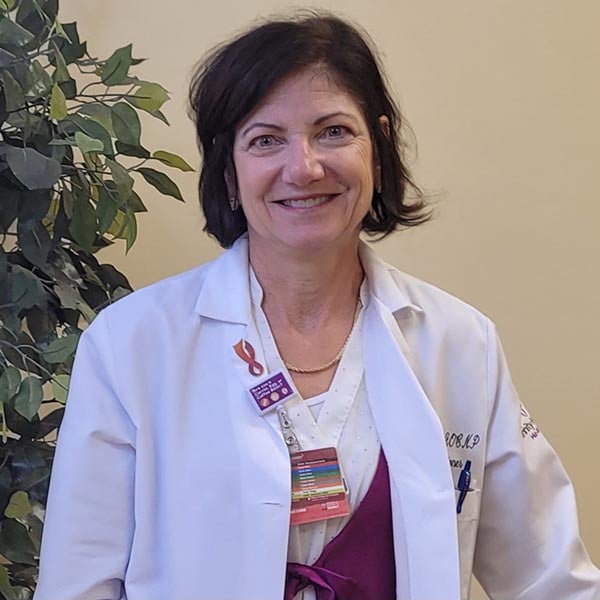 Each day, upon walking through the doors of Mercy Fitzgerald Hospital, oncology nurse practitioner Regina Poole, CRNP, experiences the joy of doing what she loves most: helping cancer patients feel knowledgeable, hopeful and in control of their unwanted diagnosis.
As the coordinator of the hospital’s Survivorship Program, which begins at the time of diagnosis and continues through treatment and remission, Poole meets one-on-one with each patient at various points during their cancer journey. For her, it’s all about building trust, allowing them to feel comfortable asking questions and expressing concerns about what’s to come.
“It’s feeling like you’re making a difference,” says Poole. “It’s having that ability to help people find the resources, help and care that they need to live a good life.”
Supporting patients through survivorship
During these conversations, Poole educates patients on their diagnosis, from providing diagrams on what the cancer looks like to candidly explaining next steps in the treatment plan. Once their treatment is underway, Poole meets with them again to address any acute or long-term side effects they may be experiencing, such as fatigue, hot flashes, anxiety, insomnia, nausea and neuropathy.
When treatment is complete and the patient is in remission, Poole’s focus turns to helping them stay healthy and cancer-free. At this point in their journey, she talks with them about general screening guidelines and follow-up care, diagnostic tests and how to resume normal activities—and life in general—after treatment. This can be difficult, with many patients struggling financially, socially and/or emotionally following such a traumatic event.
“[We] help them find the resources they need in these areas with the help of our staff and social services. Survivorship includes preventive care, but also encompasses addressing psychosocial issues, such as body image, anxiety and fear,” says Poole. “There are quality of life issues from treatment side effects and opportunities to keep patients engaged in the Mercy Fitzgerald health system for surveillance.”
For example, one of Mercy Fitzgerald’s nurse navigators hosts a monthly cancer support group, providing patients with an opportunity for connection and education. Poole also helps connect them with partner organizations, which have a variety of initiatives to further promote health and wellbeing. These include Unite for Her, a nonprofit that provides integrative therapies to breast and ovarian cancer patients at no cost, and Livestrong, a free 12-week fitness program that allows cancer patients to work with a certified trainer twice a week on cardio conditioning, strengthening and flexibility.
“We help them find the resources they need in these areas with the help of our staff and social services. Survivorship includes preventive care, but also encompasses addressing psychosocial issues, such as body image, anxiety and fear.” – Regina Poole, CRNP
Once a patient is cancer-free, Poole typically meets with them once or twice more to discuss any new or unresolved issues. She reflects on one patient in remission who was preparing to return to work after surviving aggressive breast cancer, and undergoing chemo and surgery. While speaking with her during their one-on-one conversation, Poole quickly noticed signs of anxiety in the patient. Thanks to the trust built throughout the patient’s cancer journey, she felt comfortable opening up to Poole about not only the anxiety, but the negative feelings around her body image post-surgery. It was an epiphany moment, with the patient able to receive concrete next steps toward feeling better.
“She never dealt with a lot of issues while going through her treatment. She just kind of plowed forward. And now, she’s starting to process it. I was able to recognize that she was anxious and talked to her about counseling. I got her an appointment with a counselor,” says Poole. “She seemed so grateful because she really felt heard. I don’t even think she recognized her own anxiety. But once we started talking, she was able to put it all together, that maybe how she was handling things wasn’t going to serve her over the long haul.”
Poole stresses that the Survivorship Program is a true team effort, with doctors, surgeons, oncologists, radiologists and more all uniting to meet patients where they are and work toward positive outcomes. All cancer patients—whether Stage 1 or Stage 4—are part of the program, which typically addresses solid tumors like breast, colon, lung and prostate.
Finding her calling
Despite a deep passion for her work, Poole didn’t initially aspire to a career in health care. After graduating from high school, she served as a secretary. However, after a few years of this—and watching all her friends go off to college—she realized that she was meant to do more. At community college, she took a variety of general education classes and immediately gravitated toward the sciences. She also realized that she had an innate love for helping people. Poole’s career path quickly became obvious: nursing.
Her early nursing journey took her to the med-surge floor and ICU for several years. All the while, advanced nursing programs were becoming steadily more popular.
“I loved being a nurse and I am still a nurse. But I started thinking that I could have a little bit more impact in the overall care of the patient as a nurse practitioner,” says Poole. “As a nurse, I really liked being able to take care of the patients and see them as people. As a nurse practitioner, that has carried on. It’s more holistic, so we’re looking at all the different areas of a patient that makes them a whole person. I enjoy that facet of it.”
For anyone who is considering a career as a nurse practitioner, Poole recommends spending an ample amount of time as a nurse before pursuing an advanced degree. This allows the opportunity to shadow experienced nurses and get a sense of which area is the best fit, whether it’s oncology, pediatrics or something else.
“I’m so grateful I became a nurse practitioner. I feel as though it has helped me professionally and as a person. I’m able to really give to the patients holistically and see them as a person—all the different little parts that make them who they are, and being able to meet them where they are,” says Poole. “And I’m grateful that I’m at Trinity. What drew me here was their mission statement, their core values. They aligned with my own values. I really like that our whole focus here at Mercy is providing mercy. We don’t turn anybody away.”
When Poole isn’t at Mercy Fitzgerald helping patients navigate their cancer journeys, she is participating in community initiatives—like home-building events and Christmas gift collections—with her church, gardening, spending time with her husband and four kids, or reading a riveting mystery novel with her 99-year-old mother.