
Faces of Trinity Health Mid-Atlantic: Dennis Jarosz and Lillie
April 28, 2026Categories: Faces of Trinity Health Mid-Atlantic
This series spotlights colleagues and volunteers who help create a safe, healing and compassionate environment both in and out of the hospital.
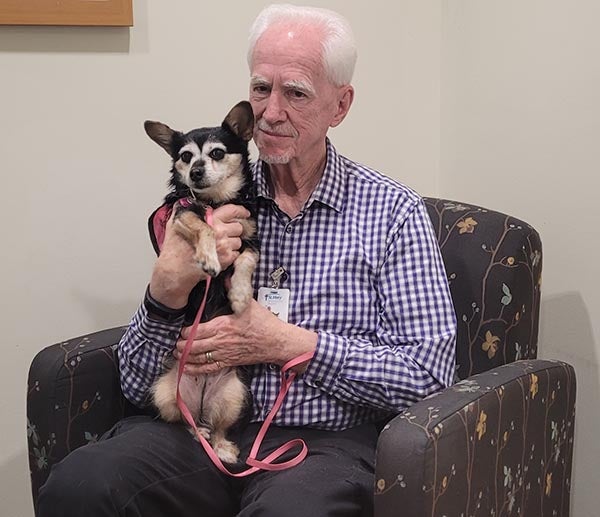 Every week, the tiniest of celebrities graces the halls of St. Mary Medical Center and St. Mary Rehabilitation Hospital, delivering small, much-needed moments of joy to patients and colleagues alike.
Lillie, a 14-year-old Yorkshire/Papillion mix, is a pet therapy dog with more than a decade’s worth of experience under her furry belt. She, along with her “dad,” Dennis Jarosz, have been volunteering at St. Mary Medical Center (Tuesday afternoons) and St. Mary Rehabilitation Hospital (Thursday afternoons) since Jarosz experienced firsthand the power of pet therapy.
“I had a surgical procedure at St. Mary Medical Center and had to stay there for a few days. While I was there, a woman visited me with a dog—a therapy dog. Until that time, I didn’t even realize there was such a thing,” says Jarosz. “When I got out of the hospital and went home, I looked at Lillie and said, ‘We’re going to do some work to become a therapy team. That looks like something very worthwhile’.”
And worthwhile it’s been.
From a semi-conscious stroke victim who held Lillie’s paw and prayed—the strongest response staff had seen from this patient since she arrived at the hospital—to a young quadriplegic who giggled as Lillie licked his face, the heartwarming stories of Lillie shedding some light in an otherwise dark and worrying time are endless.
“It gives real meaning to the old adage that it’s better to give than to receive,” says Jarosz. “To see the joy in people’s faces and how happy that short visit makes them, it’s amazing. We’re the only ones who come in the room who don’t want to poke them, prod them or try to do things to heal them. It just makes me feel so good.”
From the moment Jarosz and his wife met Lillie, they knew she was something special. At a Chester Springs-based animal rescue, they were introduced to several dogs, but all seemed indifferent about their presence. That is, until Lillie was brought in.
“She came bursting through the door. She ran right to me, jumped on me, licked my face, and then turned to my wife and did the same. Even though there were the employees in the room, she came right to us and got so excited,” says Jarosz. “We said, ‘That’s the one. It’s Lillie’.”
With her exuberant personality also came an innate ability to learn. After a bit of obedience training, Lillie went through the nationally recognized Alliance of Therapy Dogs testing process. Following several rounds of observation, which involved seeing if she could walk nicely on a leash, behave well around strangers and stay calm in a busy hospital setting, she passed with flying colors and received the official credentials to be a therapy dog.
Now, after more than a decade, Jarosz and Lille have their visitation routine down to a science. Over the course of a few hours, they make their way to various units, with Jarosz knocking lightly on the door (he’ll never wake a sleeping patient or startle them), introducing them to Lillie and asking if they’d like to meet her. For more than 90 percent of patients, the answer is a resounding “yes.” Jarosz then sets her gently on the bed so that the patient can pet her. Or, if they’re in a wheelchair, she’s trained to put her front legs on the armrest. As the patient gets their fill of Lillie, Jarosz engages in some conversation before they move on to the next room.
Each visit lasts only a few minutes, but it’s more than enough time to brighten someone’s day. In fact, there’s scientific evidence that supports the positive impact of pet therapy.
“When a human interacts with and pets an animal, our brain triggers our body to release oxytocin, which is a feel-good hormone. So there’s actually a real hormonal high that comes with it. It’s not just, ‘I like dogs, I like to pet them’,” explains Jarosz.
This positive impact isn’t limited to the patients—Lillie pets are available for colleagues as well.
“When we think of therapy dogs, we think of visiting patients and bringing them joy. But it’s the staff too. They always want to stop and pet Lillie, as she’s a known commodity. Most of them know her name because they see her every week and we let them pet all they want because they have a tough job caring for sick patients,” says Jarosz. “Pet therapy reaches beyond patients.”
For Jarosz, this volunteer work has given him a sense of purpose in life since retiring from his longtime career in sales and marketing. He gets to interact with folks of all backgrounds—an aspect of his profession that he sorely missed—and help provide a few moments of reprieve.
And, yes, as the human half of the pet therapy team, he’s perfectly content with his furry counterpart being the center of attention.
“Thousands of people know her name. I always kid that only a couple know mine,” says Jarosz with a laugh. “When people ask me my name, I say it’s ‘Lillie’s dad’.”